¶ Grafana Authentication via Keycloak (OIDC)
This document describes how to integrate Grafana with Keycloak using OpenID Connect (OIDC). The setup is suitable for Kubernetes deployments where TLS is terminated externally (e.g. via HAProxy or an ingress controller).
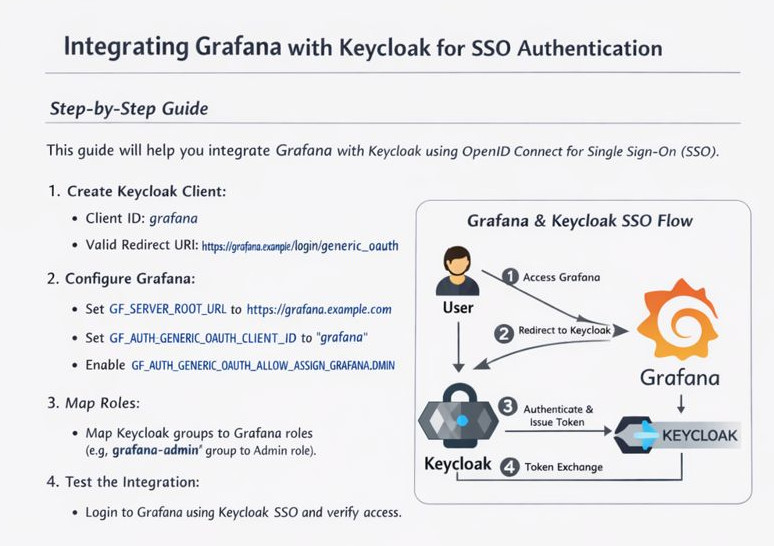
¶ Overview
- Authentication protocol: OpenID Connect (Authorization Code flow)
- Identity Provider: Keycloak
- Service Provider: Grafana
- TLS termination: External (HAProxy / Ingress)
- Grafana deployment: Kubernetes
This setup enables:
- Single Sign-On via Keycloak
- Group-based role mapping (Viewer / Editor / Admin)
- Optional removal of local Grafana users
¶ Keycloak Configuration
¶ Create Client
- Client type: OpenID Connect
- Client ID:
grafana - Client authentication: Enabled
- Standard flow: Enabled
- Implicit flow: Disabled
- Direct access grants: Enabled [1]
¶ Redirect & Origin Settings
Assuming Grafana is exposed at:
https://grafana.example.net
Set the following:
Valid Redirect URIs
https://grafana.example.net/login/generic_oauth
Valid Post Logout Redirect URIs (optional)
https://grafana.example.net/

Web Origins
https://grafana.example.net
(or + during testing)
¶ Token Mappers
Ensure these claims are present in the ID token:
| Claim | Source | Notes |
|---|---|---|
preferred_username |
User property | Required for login |
email |
User property | Optional but recommended |
groups |
Group membership | Used for role mapping |
¶ Grafana Configuration
¶ Required Server Settings
Grafana must generate external URLs that match the public address. This is mandatory for OAuth.
- name: GF_SERVER_ROOT_URL
  value: "https://grafana.example.net"

For TLS termination at HAProxy or ingress:
- name: GF_SERVER_PROTOCOL
  value: "http"
- name: GF_SERVER_HTTP_PORT
  value: "3000"
¶ OAuth Configuration
- name: GF_AUTH_GENERIC_OAUTH_ENABLED
  value: "true"
- name: GF_AUTH_GENERIC_OAUTH_NAME
  value: "Keycloak"
- name: GF_AUTH_GENERIC_OAUTH_CLIENT_ID
  value: "grafana"
- name: GF_AUTH_GENERIC_OAUTH_CLIENT_SECRET
  value: "<client-secret>"
- name: GF_AUTH_GENERIC_OAUTH_SCOPES
  value: "openid profile email"
- name: GF_AUTH_GENERIC_OAUTH_AUTH_URL
  value: "https://keycloak.example.net/realms/<REALM>/protocol/openid-connect/auth"
- name: GF_AUTH_GENERIC_OAUTH_TOKEN_URL
  value: "https://keycloak.example.net/realms/<REALM>/protocol/openid-connect/token"
- name: GF_AUTH_GENERIC_OAUTH_API_URL
  value: "https://keycloak.example.net/realms/<REALM>/protocol/openid-connect/userinfo"
¶ Role Mapping
Example mapping using Keycloak groups:
- name: GF_AUTH_GENERIC_OAUTH_ROLE_ATTRIBUTE_PATH
  value: "contains(groups[*], 'grafana-admin') && 'Admin' || 'Viewer'"
To allow OAuth users to become Grafana Admins:
- name: GF_AUTH_GENERIC_OAUTH_ALLOW_ASSIGN_GRAFANA_ADMIN
  value: "true"
¶ User Lifecycle Notes
- Grafana assigns roles on first login
- If role mapping changes, the user must be deleted and re-created
¶ Troubleshooting
¶ Error: Invalid parameter: redirect_uri
Cause:
GF_SERVER_ROOT_URLnot set- Trailing slash mismatch
- HTTP/HTTPS mismatch
Resolution:
- Explicitly set
GF_SERVER_ROOT_URL - Restart Grafana
¶ Optional Hardening
Disable local logins after validation:
- name: GF_AUTH_DISABLE_LOGIN_FORM
  value: "true"
¶ Sidenote
Above is described a way very often used utilizing variables as key-value pairs in the deployment section. Personally I prefer not to use that, as it pretty much clutters the manifest. Here is a better way of doing that:
---
apiVersion: v1
kind: ConfigMap
metadata:
  name: grafana-config
  namespace: grafana
  labels:
    app: grafana
data:
  GF_SMTP_ENABLED: "true"
  GF_SMTP_HOST: "<host>:25"
  GF_SMTP_SKIP_VERIFY: "true"
  GF_SMTP_FROM_ADDRESS: "<emailaddress>"
  GF_SMTP_FROM_NAME: "Grafana"
  GF_SERVER_ROOT_URL: "<root_url>"
  GF_SERVER_DOMAIN: "<domain>"
  GF_SERVER_ENFORCE_DOMAIN: "true"
  GF_SERVER_PROTOCOL: "http"
  GF_SERVER_HTTP_PORT: "3000"
  GF_AUTH_GENERIC_OAUTH_ALLOW_ASSIGN_GRAFANA_ADMIN: "true"
  GF_AUTH_DISABLE_LOGIN_FORM: "true"
Then within the deployment, the config map simply is referenced:
  containers:
        - name: grafana
          image: grafana/grafana
          imagePullPolicy: IfNotPresent
          ports:
            - containerPort: 3000
          envFrom:
            - configMapRef:
                name: grafana-config
But of course this is all up to whom it conerns.